Rev. Joseph Allen Family Letters
A Family of Letters – Rev. Joseph Allen Family Letters from May 1820 – November 1847- presented by Northborough Historical Society on February 27,2009. https://www.youtube.com/watch?v=RsHV8OZarB4


New Native American trail historic marker in Northboro


New Native American trail historic marker in Northboro
Submitted by Norman Corbin, Northborough Historical Commission
Northborough – Did you know there was an important Native American trail that crossed through Northborough? A new historic marker has been installed to commemorate its history and location. Well before any European colonization of North America, the native population had many trails that acted as routes to food sources and neighboring tribal nations. Some of the major trails can be considered as their form of a super highway. A significant trail passed through lands that are now part of Northborough. It was a loop trail that separated from what the Europeans called the Connecticut Path in Sudbury and reconnected with it in Grafton. The Connecticut Path was the major trail connecting the Massachusetts Bay with the Connecticut River; it travelled south of Northborough. After starting in Sudbury, the loop trail travelled into Marlborough. It roughly proceeded from the current center of Marlborough along the southern shore of Lake Williams then to the base of Ball Hill in Northborough. This section would not be very different from travelling along Route 20 west to Williams Street then Forrest Street in Marlborough to Bartlett Street in Northborough. Just as it entered Northborough, it would have continued southwest over Ball Hill onto the old Westborough State Hospital property. Ball Hill is where there is a new warehouse building, along with the FedEx and A. Duie Pyle, Inc., distribution centers. The trail continued southwest leaving Northborough between Little Chauncy and Chauncy ponds into Westborough and then toward Grafton. One key attribute of this trail is that it connected the native settlements in Marlborough to the one in Grafton. The Marlborough natives were part of the Pennacook Federation of tribes that inhabited the valleys of the Merrimac and Connecticut rivers in Vermont, New Hampshire, and northern Massachusetts. They were closely related with the village of Wamesit which was located where the Concord River emptied into the Merrimack in the current city of Lowell. The Marlborough location was called “Okommakamesit” and their planting field was very near current downtown Marlborough. In 1643 they petitioned and were granted land by the General Court in Boston well before the first European settlers were granted Marlborough land in 1656. Grafton was the royal seat of the Nipmuc Nation. Their territory included central Massachusetts and adjacent portions of Connecticut and Rhode Island along the rivers and streams connected to the Blackstone, Quaboag, Nashua and Quinebaug rivers. It is estimated that there were 5,000 to 6,000 Nipmucs when the Pilgrims landed at Plymouth in 1620. Today, the Nipmuc Tribe is a “state-acknowledged” tribe and very active in the community. Their reservation land in Grafton is called Hassanamesit and was granted in 1728. The current chief is Sachem Cheryll Toney Holley. Both settlements were converted to “Praying Towns” between 1650 and 1675 by Rev. John Eliot of Roxbury. One can easily imagine Reverend Elliot traversing this trail as he taught the natives Christian values. During King Philip’s War between the colonists and natives (1675 to 1678) this trail became an important route. The new marker is located on the Wachusett Aqueduct Trail just south of where it crosses Bartlett Street near the Marlborough line. The Northborough Historic District Commission would like to express their gratitude to TA Realty for purchasing the sign and MWRA for installing it on their right-of-way. For additional information:
Nipmuc Nation Website: http://www.nipmucnation.org
“The Great Trail of New England” by Harral Ayres, Meador Publishing, 1940
At Long Last, Women Get to Choose, Too
By Kathy Pierce (Northborough Historical Society Historian)
It was November 2, 1920, and 38-year-old Ida A. Johnson of Main Street was about to do something she had never done before. For the first time, Ida, along with thousands of other women across the country, would cast her vote for the president of the United States. In fact, Ida was the first woman in Northborough that day to check off her choice for that office.

carried Ida Van Horn in the front supporting the flag, with Mrs.
Samuel Maynard and Mrs. William Stearns in the back.
After 70 years of a hard-fought national campaign, women gained that suffrage right through passage of the 19th Amendment to the U.S. Constitution in August 1919. The amendment proclaimed that the “right of citizens of the United States to vote shall not be denied or abridged by the United States or by any State on account of sex.”
Another local woman who exercised her new right that day was Rosa Crosby Warren. “It’s town meeting day. In the afternoon, I went down and voted for the first time. Olive (her daughter) went in the forenoon,” Rosa wrote in her Nov. 2 diary entry.
There was likely a good bit of rejoicing here when the 19th amendment passed as local women had pushed for their right to vote in town elections for decades. Way back in 1881, 1882 and 1883, the warrants for the annual town meeting listed this article: To see whether the Town will, by its vote, or otherwise, ask the Legislature to extend to women, who are citizens, the right to hold Town offices and vote in Town affairs as male citizens. The 1881 warrant says the article was included “by request of Hon. W.T. Bowditch, Lucy Stone and others.” Bowditch and Ms. Stone were staunch advocates of woman suffrage.
The late Dorothy Burnham Rose, who at 98 was the oldest town resident in 1985, recalled in a newspaper interview that year that she had attended rallies for suffrage as a young woman despite her father’s objections. He thought the suffragettes were a “bad crowd” and he did not favor giving women the vote. Ms. Rose, however, said she and a friend who accompanied her to the rallies “were quite convinced it was right.”

What may come as a surprise to some is that women had been able to vote for and serve on local school committees for many years before 1920. In 1879, the Massachusetts legislature agreed to allow women to vote for and serve as School Committee members. At that time, about 5,000 women in the state registered to vote.
It appears, however, that women served on school boards well before the state legislation passed. Likely they were elected by or appointed by male town residents or officials. The 1876 Northborough town report notes that Sarah Allen was paid $53 for service to the School Committee. Frances Chesborough is listed as a member of the School Committee in 1878. The 1880 town report expressed regrets at her resignation and acknowledged that “her long and valuable services as a member of this committee have done so much to advance the interests of our schools.”
Following Ms. Chesborough came Harriet Allen, whose term expired in 1882; Elvira Johnson, who served from 1883 to 1889 and Lucy Davis, who served two terms. Under the recent state law, women voters would have had a say in choosing those three members. By 1892, 161 women were serving on school boards in 112 Massachusetts communities, according to PrimaryResearch.org.
But that’s as far as women’s voting rights went until the 19th Amendment passed in 1919. Here in Northborough, 278 women registered to vote in 1920 alone, according to records preserved at the Town Hall and graciously retrieved for this article by Town Clerk Andy Dowd. They brought the total of local women eligible to vote in the national race to 363.
Overall 737 town residents voted that year. Warren G. Harding, the Republican candidate, won locally and nationally to become the new president.
Interestingly, most of the women who registered before 1920 signed on in 1911. As noted, they could only vote for School Committee members. Why such a flurry all of a sudden? A look through Historical Society archives found that a contentious School Committee race that year drew out two opposing factions. An account of that race will make a spicy topic for a future History Corner article.
As for Ida Johnson and other women voters here, it didn’t take them long to jump into local political activities. The September 1920 meeting minutes of the formerly all-male Northborough branch of the Republican League noted that the “large audience in attendance included many ladies.”

On January 25, 1921, Ida was appointed to the nominating committee for the organization’s next slate of officers. Among those tapped for the positions were Jessie M. Potter for vice president, Almira A. Wadsworth for Membership Committee chairman and Mrs. Walter Brigham, Music Committee chairman.
Soon after, a Mrs. Knowlton of the Republican State Committee gave some wise guidance at the July 1922 meeting of the town Republican League.
“She addressed herself particularly to the women and urged them to ascertain for themselves the honesty, ability and experience of the candidates in order that they might vote intelligently and wisely.”
Sound advice, ladies.
“Ghosts In The Graveyard” at Northborough’s Howard Street Cemetery
“Ghosts In The Graveyard” at Northborough’s Howard Street Cemetery https://www.youtube.com/watch?v=NX_ztuZe6sY


Northborough’s Gale Store Restoration & Conversion to Housing
Congratulations to the team, partners and community behind Northborough’s Gale Store Restoration & Conversion to Housing for receiving a 2020 Robert H. Kuehn, Jr. Award! The Kuehn Award recognizes projects that meld collaborative partnerships with creative and cutting-edge ideas for the rehabilitation and active reuse of historic buildings. https://www.youtube.com/watch?v=q2lo8YHe1vo


OUR HISTORY
The Northborough Historical Society was founded in 1906 through the efforts of Reverend Josiah C. Kent. Rev. Kent invited a group of townspeople to meet at the Unitarian parsonage on November 6, 1906 to consider the desirability of organizing such a society. Nine men and four women responded favorably to Rev. Kent’s plea that “the facts of Northborough history should be collected and thus preserved from oblivion.”
Read this article written by Northborough Historical Society’s Historian Robert Ellis, published in The Record on May 18, 2006, titled “Historical Society Respectful of Northboro’s past.”


The Northborough of today was in 1660 part of the sprawling frontier town of Marlborough, a chunk of which broke away as Westborough in 1717. Few people then lived in the bounds of present-day Northborough, but by 1744 there were thirty-seven families here, and Westborough recognized the area as its northern “precinct”, entitling it to its own meeting house at the site of the present Unitarian Church near the juncture of Church and Whitney Streets.
Northborough in turn gained its independence in 1766. A patriotic town, Northborough supplied its minutemen to the American Revolution. Anti-slavery sentiment grew in the 1830s; in the following decade the town vigorously protested the annexation of Texas with its concomitant threat of the extension of slavery. A Northborough native, John Davis, cast one of only two votes in the United States Senate against the declaration of the Mexican War in 1846. A large contingent of Northborough men volunteered for action in the Civil War, which resulted in the end of slavery.
Meanwhile Northborough grew as a village of farms and mills on the Assabet River and other streams. The nineteenth century saw the development of manufacturing: farm tools, woolen and cotton cloth, ornamental combs, buttons, bricks, shoes and cameras were among the town’s products. The railroad came to Northborough in 1856 and street railway lines in the 1890s.
For many years Northborough retained its largely rural character. As late as 1940 only 2,382 people lived here. In the decades after World War II many people who worked in Worcester, Boston and elsewhere found Northborough a congenial place to live. By the mid-1970s, with Route I-290 crossing town in the north as well as Route 20 (the historic Boston Post Road) in the center and Route 9 in the south, over ten thousand people called Northborough home.
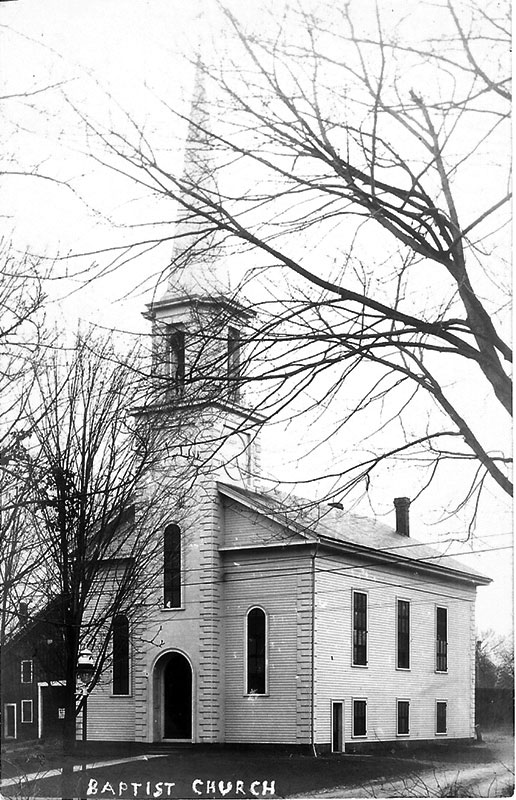
 The Northborough Historical Society, founded in 1906, is dedicated to increasing the appreciation of the town’s rich and varied history. Our museum in the former Baptist Church at the corner of Main and School Streets (open, free to the public, on Sunday afternoons in spring and fall) boasts a fine collection of objects of Northborough art and history. Our archive, with its thousands of documents and pictures, is available to researchers.
We sponsor monthly programs and various educational outreach activities. Meetings are usually held on the fourth Friday evening of the month. Typical programs have included “A Video Tour of the White Cliffs” (once the summer home of the millionaire firearms manufacturer Daniel Wesson); “Northborough Artists Past and Present”, and “New England History and Tradition Through Song”. Another benefit of membership is the Hourglass, the monthly newsletter of the Historical Society. For more information about the Society and membership please call 508.393.6298. Whether interested in joining or not, guests are always welcome at the monthly meetings
ABOUT US
For more than 100 years, we have been dedicated to the study and preservation of the history of our town of Northborough, Massachusetts.Welcome to the Northborough Historical Society
- Our monthly programs feature a wide variety of excellent speakers on topics of historical interest to our town and our community. These events are open to the public and take place at 7:30 p.m. one Friday each month, September through June. Here are photos from our past meetings and events.
- Our archive is home to an impressive collection of primary source material concerning the history of the people, the land and the structures of Northborough. Our Curator Ellen Racine can be reached at 508.393.2343 or at Info@NorthboroughHistoricalSociety.org. For historical research, contact Kathleen Pierce at Historian@NorthboroughHistoricalSociety.org
- Our museum houses a variety of displays of historical artifacts and treasures of Northborough and is open to the public from 2-4 p.m. Sundays in May, June, September and October, and by special arrangement.
- Our building, located at 52 Main Street, is a former Baptist Church and houses a fully-restored 1874 pipe organ.
- Membership in the Society is open to all, and tax-deductible yearly dues help to defray the cost of our offerings. Single membership are $20; Student and Senior Citizen memberships are $15. Families can join for $45 and Lifetime Memberships are $250. Additional donations are also accepted. Members enjoy our monthly newsletter; free admission to our programs; inclusion in members-only events; and a 10% discount on merchandise at our museum shop. Go to our MEMBERSHIP PAGE for forms and mailing information.


BOARD OF DIRECTORS
President: Ken Bennett Vice President: Rick Ferenchick Secretary: Hilary Wilson Treasurer: Dale Williams Membership Secretary: Jean Langley Directors: Mike Duchesneau, Allyn Phelps Jr., Lois Smith, Michael Mills, Chair Trustees: Bill Webster Chair Property Committee: Chuck Liljestrand
Applefest Parade 2016 on Northborough’s 250th Anniversary https://www.youtube.com/watch?v=0zwAiV8IDtI


1915 Northborough Highschool


Guerdon Bennett
Flora Murray Army Nurse in Europe WW1


1930’s Texco Gas Station at 35 W. Main St and 3 story Northboro Hotel that burned in 1926 are pictures from the former NHS Historian, Bob Elles’s article ‘A Northborough Common’ in the NHS website. http://northboroughhistoricalsociety.org/historian.html
 Northboro History